
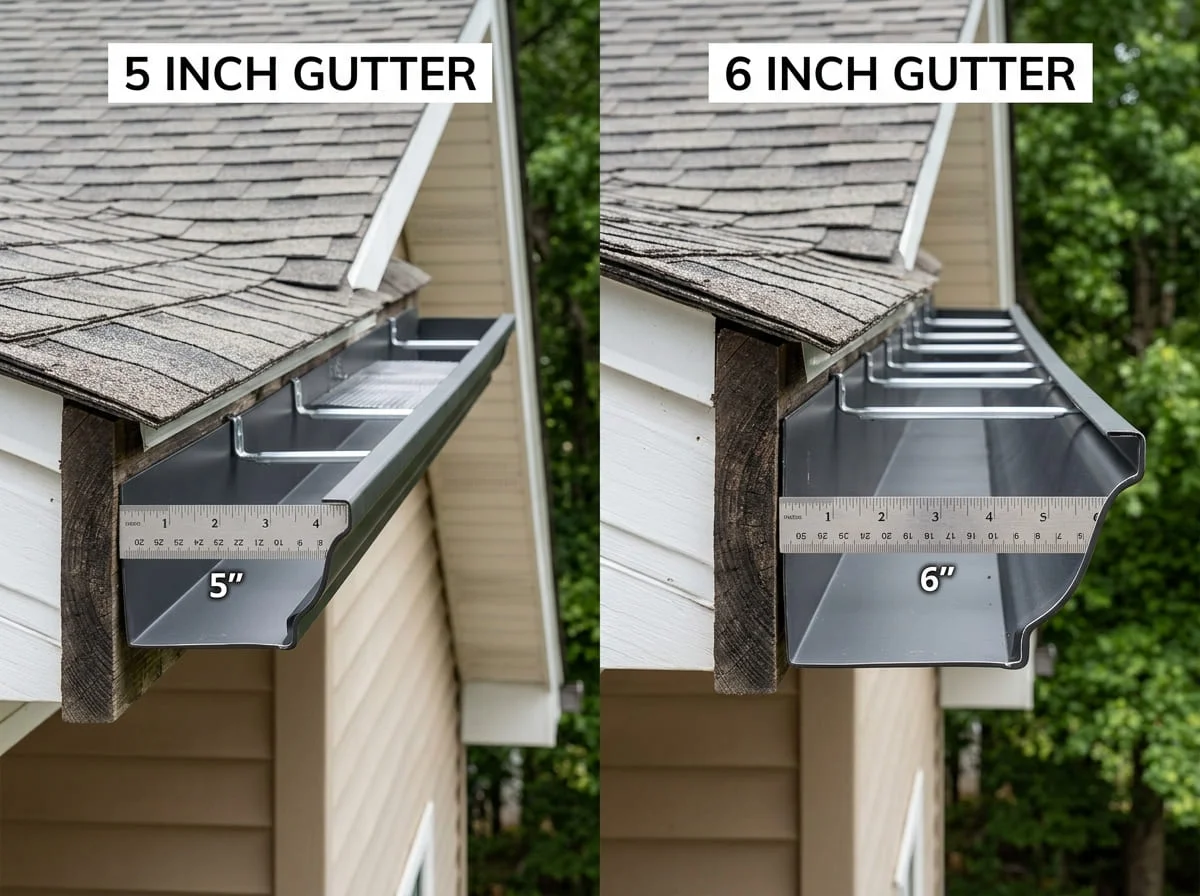
Most homes in America come with 5-inch gutters by default. In a lot of the country, that’s fine. In Texas — where a single storm cell can dump several inches of rain in an hour — the standard size is often the wrong call. Choosing between 5-inch and 6-inch gutters is really a question about how much water your roof has to move, fast, when the sky opens up.
Here’s how the two sizes compare, and how to tell which one your home actually needs.
The capacity difference is bigger than one inch sounds
An extra inch of width doesn’t sound like much until you look at what it does to volume. A standard 5-inch K-style gutter holds about 1.2 gallons of water per foot. A 6-inch gutter holds roughly 2.0 gallons per foot — about 67% more capacity in the same length of run.
Flow rate tells the same story. Move up to 6-inch troughs with larger downspouts and the system can carry on the order of 40–50% more water per hour than a 5-inch setup. That headroom is exactly what you want when a Gulf Coast or Hill Country storm arrives all at once instead of drizzling in politely.
When a gutter can’t keep up, the water doesn’t wait — it pours over the front edge, sheets down the fascia, and lands right against your foundation. In Texas, where much of the state sits on expansive clay soil that moves with water, that overflow is how gutters end up causing foundation problems instead of preventing them.
Downspouts: the other half of the equation
Gutter size is only part of the picture. The downspouts drain the trough, and they have to keep pace.
- 5-inch gutters usually pair with 2x3-inch downspouts and need one roughly every 30–35 feet. Runs longer than about 40 feet on a single downspout can get overwhelmed in heavy rain.
- 6-inch gutters typically pair with larger 3x4-inch downspouts and can span 50–60 feet with proper pitch and placement.
That’s a real practical advantage on a bigger home: fewer downspouts, cleaner lines, and more water moving per outlet. Just remember the pairing matters — upsizing the gutter without upgrading to a 3x4 downspout leaves much of the capacity gain unused.
When to choose each size
Here’s the honest breakdown.
Go with 6-inch gutters if:
- Your roof is large (roughly 2,000+ square feet of drainage area) or has steep pitches that dump water fast
- You live anywhere that sees intense, high-volume rain — which covers most of Texas
- You have long roof runs where you’d rather not add extra downspouts
- Your current 5-inch gutters overflow during hard storms
- You’re feeding a rainwater collection system and don’t want to lose water to overflow
5-inch gutters can work if:
- Your roof is small (individual planes around 600–800 square feet)
- Your home is in a lower-rainfall pocket with simple, low-slope roofing
- Budget is the deciding factor and your roofline is short and straightforward
For a large share of Texas homes, the roof area and rainfall intensity tip the decision toward 6-inch — even when a generic national sizing chart would say 5-inch is enough. Those charts are built around average rainfall, and Texas storms are anything but average.
Does the bigger size cost more? Yes — and it’s usually worth it
Six-inch gutters use more material per foot and pair with larger downspouts, so they cost a bit more up front than 5-inch. But the added cost is modest, and it buys you a system that keeps up when it counts. Weighed against the price of repairing water-damaged fascia or a foundation that’s started to move, sizing up is cheap insurance.
If you’re already planning new gutter installation or a gutter replacement, the size decision is the moment to get it right — it’s far easier to install the correct size once than to retrofit later.
The bottom line
The 5-inch versus 6-inch question comes down to a single idea: your gutters have to move all the water your roof sheds, during the hardest rain you get, without overflowing. In Texas, that bar is high. For many homes here, 6-inch gutters with 3x4 downspouts are the size that actually clears it — and seamless construction on top of the right size gives you a system with fewer joints, fewer leaks, and a longer life.
Not sure which size fits your roof? The right way to know is to have the roofline measured and the drainage calculated for your specific home and local rainfall. Contact us for a free estimate and we’ll size it correctly the first time.