
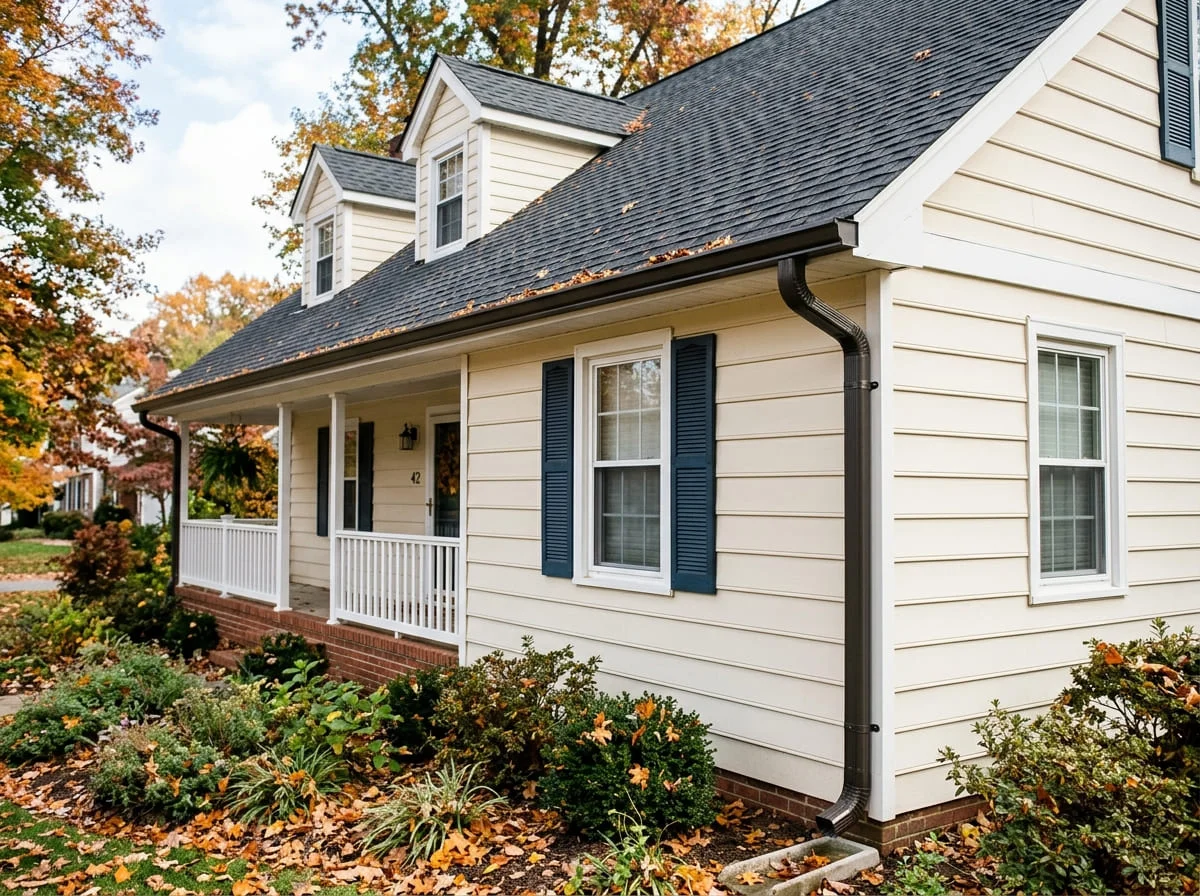
If you own a home in Texas, the biggest threat to your foundation isn’t a dramatic flood or a shifting fault line. It’s something far quieter: the soil under your house getting wet, then drying out, then getting wet again. That cycle repeats with every storm and every drought, and over time it can crack a slab, split brick, and lead to a repair bill that buys a used car. Your gutters are one of the cheapest, most effective defenses against it.
Here’s how the damage happens, and how the right gutter and downspout setup stops it.
The short version: it’s the clay soil
Much of Texas — from the Blackland Prairie through Central Texas and into North Texas — sits on expansive clay soil. This kind of soil acts like a sponge. When it takes on water, it swells and pushes upward and outward. When it dries out, it shrinks and leaves gaps.
Your foundation rests on that soil. So when the clay under one part of your house swells while another part dries and contracts, the slab is forced to move with it. That uneven movement is what cracks foundations, and it’s why Texas has one of the busiest foundation-repair industries in the country.
Rain water is the single biggest variable you can actually control. And the tool that controls it is your gutter system.
How uncontrolled roof water wrecks a foundation
Picture a home with no gutters, or with gutters that overflow. During a storm, thousands of gallons sheet off the roof and land in a narrow band right against the foundation. That soil gets saturated fast, swells hard, and presses against the slab and footing.
Then Texas does what Texas does: the rain stops, the sun comes out, and that same saturated clay begins to dry and contract — leaving voids beneath the foundation that let it settle into the gaps. Swell, shrink, swell, shrink. Each cycle is a small movement, but repeated over seasons it’s relentless, and concrete doesn’t flex. It cracks.
The tell-tale signs show up inside and out:
- Cracks in brick, drywall, or the slab
- Doors and windows that suddenly stick or won’t latch
- Gaps opening at the corners of door frames
- Floors that feel sloped or uneven
- Outside: pooling water, washed-out mulch, and soil separating from the foundation
Most of those problems trace straight back to where the roof water went.
How gutters break the cycle
Gutters do one job that matters enormously here: they take the water that would have dumped at the base of your house and move it somewhere safe.
A properly built system catches every bit of roof runoff, channels it into downspouts, and releases it a safe distance from the foundation. The soil around the slab stays at a more even moisture level instead of swinging between soaked and bone-dry. Stable moisture means stable soil, and stable soil means a foundation that isn’t being pushed and pulled apart.
Two details make or break it:
Sizing. The gutters have to keep up with Texas rain. A builder-grade 5-inch gutter often can’t carry the volume of a hard Hill Country or Gulf Coast cell, so it overflows — and overflow lands exactly where you don’t want it. Stepping up to 6-inch gutters with larger downspouts is a common fix. Correct gutter installation starts with matching the system to your actual roof area and rainfall.
Downspout discharge. This is where a lot of otherwise-good systems fall short. Codes generally require moving water at least 5 feet from the foundation, but on Texas clay the drainage pros push for 6 to 10 feet. A downspout that ends right at the slab is barely better than no gutter at all. Extensions, splash blocks, or buried drain lines carry the water out to where it can’t hurt you — and if a downspout has pulled loose or drains too short, downspout repair is a quick, high-value fix.
The mistakes that keep causing slab damage
Even homes with gutters run into trouble when the details are wrong. The usual culprits:
- Downspouts that discharge too close to the foundation
- Undersized gutters that overflow in every real storm
- Clogged or sagging runs that spill over the back edge onto the fascia and soil
- Negative grading that slopes the yard back toward the house
- Leaking seams on sectional gutters that leak water right at the wall
If your gutters are overflowing, leaking, or dumping water at the base of the house, they’re not protecting your foundation — and the fix is usually far simpler and cheaper than people expect. Gutter repair to reseal, re-pitch, or re-secure a tired system often restores its drainage in a single visit.
Why this is the cheapest insurance on your house
Foundation repair in Texas routinely runs into the thousands, and serious underpinning or pier work can reach well into five figures. A complete gutter and downspout system costs a small fraction of that. Spending a few hundred to a few thousand dollars keeping water away from your slab is dramatically cheaper than fixing what happens after the clay has already moved.
That’s the entire case for drainage. You can’t change the soil your home sits on, but you can absolutely control where the rain goes.
Protect your foundation before the next storm
If you’ve noticed pooling near the house, overflowing gutters, or the first hairline cracks showing up inside, don’t wait for the pattern to get worse. Getting your gutters sized correctly and your downspouts draining well away from the slab is one of the best-value upgrades a Texas homeowner can make.
Contact us for a free estimate and we’ll take a look at how your system is handling the water — and where it’s putting it.